

Every year, from November 25 to December 10, organizations around the world join forces for the “16 Days of Activism Against Gender-Based Violence” campaign. This international initiative aims to raise awareness, provide public education, support people experiencing violence, and mobilize decision-makers to create and fund effective systemic solutions.
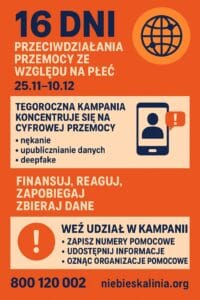
This year’s edition places particular focus on digital violence against women and girls — one of the fastest-growing yet still insufficiently recognized forms of abuse.
Why are these 16 days so important?
Gender-based violence — at home, at work, in relationships, in public spaces, and online — remains one of the most widespread human rights violations. Global data clearly shows the scale of the problem: nearly 1 in 3 women has experienced physical or sexual violence in her lifetime.
In Poland, the police register tens of thousands of domestic violence cases every year, though experts emphasize that the real number is much higher, as many people never report the abuse they experience.
The “16 Days” campaign is not only a time for reflection, but above all a time for action. It serves as a reminder that preventing violence requires cooperation between communities, public institutions, NGOs, and each of us individually.
Digital violence — a challenge of the 21st century
The development of technology has created new opportunities — also for perpetrators. Cyberstalking, online threats, sharing intimate photos without consent, deepfakes, digital control, account takeovers — these are just some of the behaviors now recognized as forms of violence.
Digital violence is often used as a tool of intimidation, isolation, and control, and in many cases leads to escalation of offline violence.
This year’s campaign highlights four key action areas: fund, respond, prevent, and collect data. States and organizations are encouraged to invest in support services, respond effectively to reports, provide digital education, and build reliable data systems to inform public policy.
The many faces of violence
The campaign reminds us that violence can take many forms:
Physical violence
Hitting, pushing, choking, or other acts violating bodily integrity. It may not always leave visible marks — but always poses a real threat to health and life.
Psychological violence
Control, intimidation, humiliation, gaslighting — all of which erode self-esteem and lead to isolation. It is one of the most frequently reported forms of violence.
Economic violence
Restricting access to money, forbidding work, controlling expenses. It undermines independence and autonomy.
Sexual violence
Any sexual act forced through violence, manipulation, threats, or without clear consent.
Digital violence
A growing form of abuse affecting private, professional, and social life.
Intersectionality matters
Violence does not affect everyone in the same way. Experiences vary depending on gender, sexual orientation, origin, migration status, disability, or economic situation. People from groups at higher risk face additional barriers — legal, cultural, linguistic.
Effective violence prevention requires looking through the lens of these overlapping factors.
How can we help?
Each of us can become an ally to people experiencing violence. Key actions include:
- believing and not judging,
- ensuring safety and emotional support,
- helping to collect evidence (e.g., screenshots, notes),
- accompanying someone when contacting institutions,
- not confronting the perpetrator directly if it increases risk.
Institutions also play an essential role — offering psychological, legal, and medical support, implementing anti-violence procedures, and building a culture of intervention.
Education is prevention
We must talk about violence — in schools, workplaces, universities, and local communities. Education about consent, healthy relationships, counteracting stereotypes, and digital safety is one of the most effective ways to prevent violence.
We act all year round
Although the campaign lasts 16 days, preventing violence requires year-round action — sustainable funding for support services, implementation of public policies, building a culture of equality, and consistent intervention.
If you need help or know someone who does:
800 120 002 — “Niebieska Linia” (24/7)
116 123 — Emotional support helpline
112 — in immediate danger
You are not alone. Support is available.