

🌟 Worth reading: “Including Older Adults in Social Life through Music, Community, and the DEI Approach”
💬 Our new article is now available on EPALE!
👉 Read it here (Polish): https://epale.ec.europa.eu/en/node/402175
The article shows how music, rhythm, and community can be powerful tools for including older adults in social life. These activities promote the values of Diversity, Equity & Inclusion (DEI) and are accessible to people with different abilities and life experiences. 📣
🧠 Key takeaways from the article:
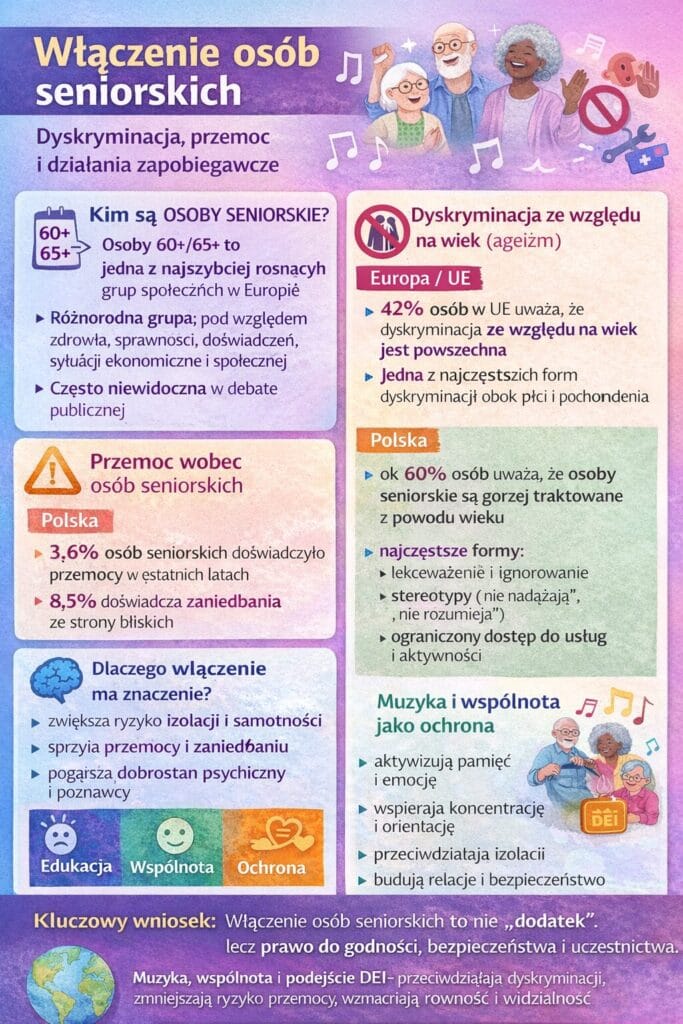
🎼 Music activates the mind – rhythm and dance stimulate cognitive functions, supporting attention, memory, and emotional stability in older adults.
💪 Preventing exclusion – music-based activities help seniors overcome isolation and strengthen their sense of agency.
👥 Social community – participation in group practices fosters a sense of belonging and counteracts loneliness and marginalization.
📊 Discrimination and violence against older adults – what is the situation in Poland and Europe?
🧓 Age discrimination
Age discrimination, or ageism, is a widespread phenomenon in Europe. According to research, as many as 42% of EU citizens believe that age discrimination is common, and older people notice such behaviors more often than younger generations. One of the most frequently reported contexts is the labor market, but discrimination also occurs in financial services, healthcare, and public spaces. (Cambridge University Press & Assessment)
In Poland, studies show that 50% of respondents believe that seniors are not treated with due respect, and nearly 60% state that they are treated worse because of their age. Reported forms of mistreatment include being ignored, indifference, inappropriate jokes, material exploitation, and intimidation. (niebieskalinia.pl)
👵 Violence against older adults
Violence against seniors is a serious social problem that often remains outside public debate. In Poland, 3.6% of older adults have experienced violence in the past three years, and 8.5% feel neglected by their families. As many as 43% of Poles have encountered violence against seniors in their surroundings. (przemocymowimystop.mrips.gov.pl)
The most frequently reported forms of violence are psychological and economic abuse, such as insults, humiliation, threats, taking money, or intimidation. Victims are more often women, older individuals, and people living in rural areas.(przemocymowimystop.mrips.gov.pl)
European data also reveal alarming figures: according to the WHO, at least 4 million older adults in Europe experience physical violence annually, 6 million experience economic violence, and 29 million experience psychological violence. Many cases are never reported or officially documented. (gov.pl)
💡 What can we do – preventing discrimination and violence against older adults?
🧠 Social education
Counteracting ageism through social campaigns, intergenerational education, and promoting positive models of ageing.(EPALE – European Commission)
Raising awareness among younger generations about age-related stereotypes — change begins with everyday attitudes and relationships.
🤝 Building community and participation
Organizing and supporting activities that increase social participation of older adults — meetings, clubs, cultural and music activities, and DEI workshops.
Including older people in decision-making processes — their experience is an added value for the whole community.
🛡️ Systemic support
Promoting public policies that protect the rights of older adults, including protection from discrimination in healthcare, employment, and public services.(Cowzdrowiu)
Ensuring access to free interdisciplinary services — legal, psychological, medical, and social — for victims of violence.
📣 Responding to violence
Increasing access to reporting mechanisms for violence against older adults — helplines, “Blue Card” procedures, and support centers.
Training professionals and volunteers to recognize signs of violence and respond appropriately.
Summary
Including older adults in social life is not only a matter of education or cultural activity — it is also a fight against discrimination, stereotypes, and violence against seniors.
Music, rhythm, and community are tools that can build spaces of equality, respect, and intergenerational partnership. Through DEI-driven actions, we create a more just society in which all voices are heard and valued — regardless of age. 🌍
📖 We invite you to read the article on EPALE — a source of inspiration for action and reflection!
👉 https://epale.ec.europa.eu/en/node/402175