

A powerful month behind us. We’ve just completed a truly meaningful time. March in our social media was dedicated to the campaign “March – Women’s Mental Strength Month.” Over four weeks, we co-created a space full of empathy, knowledge, and mutual support—showing that solidarity is our greatest strength.
Through a series of educational posts, we explored phenomena that shape our everyday reality but often remain unspoken. We talked about psychological agency—the ability to regain control over our own lives—and about sisterhood as a real alternative to imposed competition. We examined socialization mechanisms that push us into the “good girl” mold and deconstructed imposter syndrome, which so often makes us doubt our own achievements.
This article is both a summary and a deeper reflection on those March conversations. We invite you to read on and build your own practical “toolkit” for fighting for your authenticity.
Reclaiming your voice: on dismantling imposed roles, imposter syndrome, and the power of agency

Pause for a moment. How many times in the past week did you feel that your successes were just “luck”? How often did you stay silent because “girls shouldn’t argue”? Our identity often resembles a tight corset woven from expectations—those of significant others, media, and traditional socialization. It’s time to loosen it.
Where does the “good girl curse” begin?
Our personalities are shaped by thousands of messages. As noted by M. Nowak-Dziemianowicz, girls’ worlds are often confined to neat rooms, where dolls replace tools for exploring reality. We are taught to be dependent, passive, and always smiling. When we act differently, we are labeled “difficult” or “bossy.” This training in “niceness” often leads adult women to lose touch with their own needs and live in constant fear of disapproval.
The trap of imposter syndrome
From this upbringing emerges imposter syndrome—the exhausting inner voice that tells you that you’ve “fooled everyone” and don’t deserve your position. Women often believe their skills are merely “learned,” not innate. This leads to overworking, harsh self-criticism, and fear of advancement. While others move forward, many of us withdraw—burdened by responsibilities and the feeling of “falling behind.”
Your shield: psychological agency
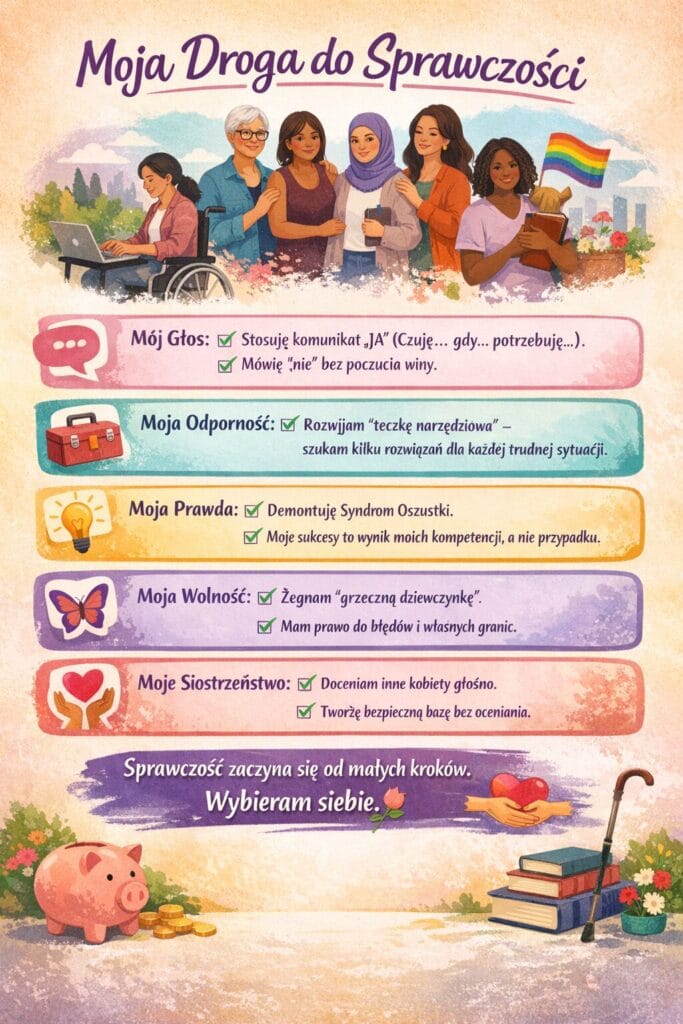
The greatest form of freedom is psychological agency—the deep sense that you are steering your own life.
It fuels motivation, builds courage, and strengthens resilience. When your sense of agency is high, you trust your ability to cope because you are creative and capable of finding solutions.
Its opposite is learned helplessness—a state where you give up because past experiences or stereotypes have taken away your belief in meaningful action.
How to build agency every day
- Try—even when you feel afraid. Mistakes are not failures; they are lessons that build your “toolkit.”
- Use “I” statements. Say: “I feel frustrated when my plans are ignored. I need predictability.” This is assertiveness—setting boundaries calmly and respectfully.
- Let go of perfectionism. There is no “perfect life.” True confidence comes from accepting both strengths and weaknesses.
- Choose sisterhood. Other women are your allies. Speak positively about one another, uplift each other, and create safe, non-judgmental spaces.
Question for you: What message did you hear most often as a girl? And what helps you feel today that you have real influence over your life?
DAILY AGENCY CHECKLIST
I choose myself. I build strength. I offer support.
- MY BOUNDARIES (Assertiveness)
- I listen to my body—fatigue, irritation, resistance signal that a boundary is near.
- I say “no” without guilt. My needs are a sufficient reason.
- I use “I” statements to express feelings and needs.
- MY AGENCY (Impact)
- I act despite fear. Mistakes are part of my learning toolkit.
- I look for multiple solutions and train my creativity.
- I appreciate small steps—each one builds my sense of influence.
- MY LIBERATION (Working with beliefs)
- I let go of the “good girl.” I release the pressure to always be compliant.
- I dismantle imposter syndrome. My success comes from my competence and work.
- I reject perfectionism. I choose authenticity over flawlessness.
- MY SISTERHOOD (Solidarity)
- I openly appreciate other women. Recognition is shared capital.
- I respond to injustice. I support women facing sexism or judgment.
- I listen without judgment and create safe space.
Remember: Healthy socialization does not impose roles—it gives you the freedom to be yourself.