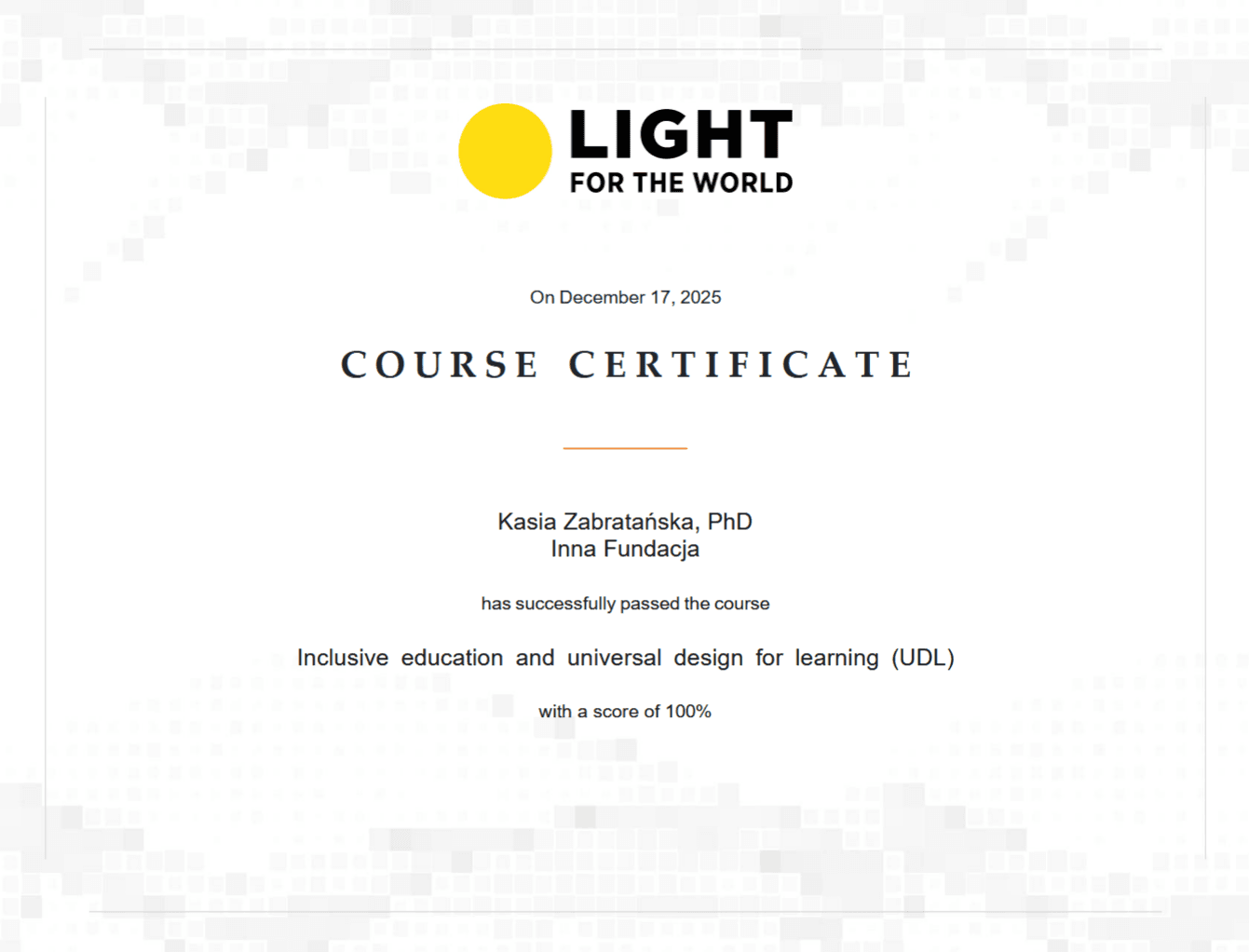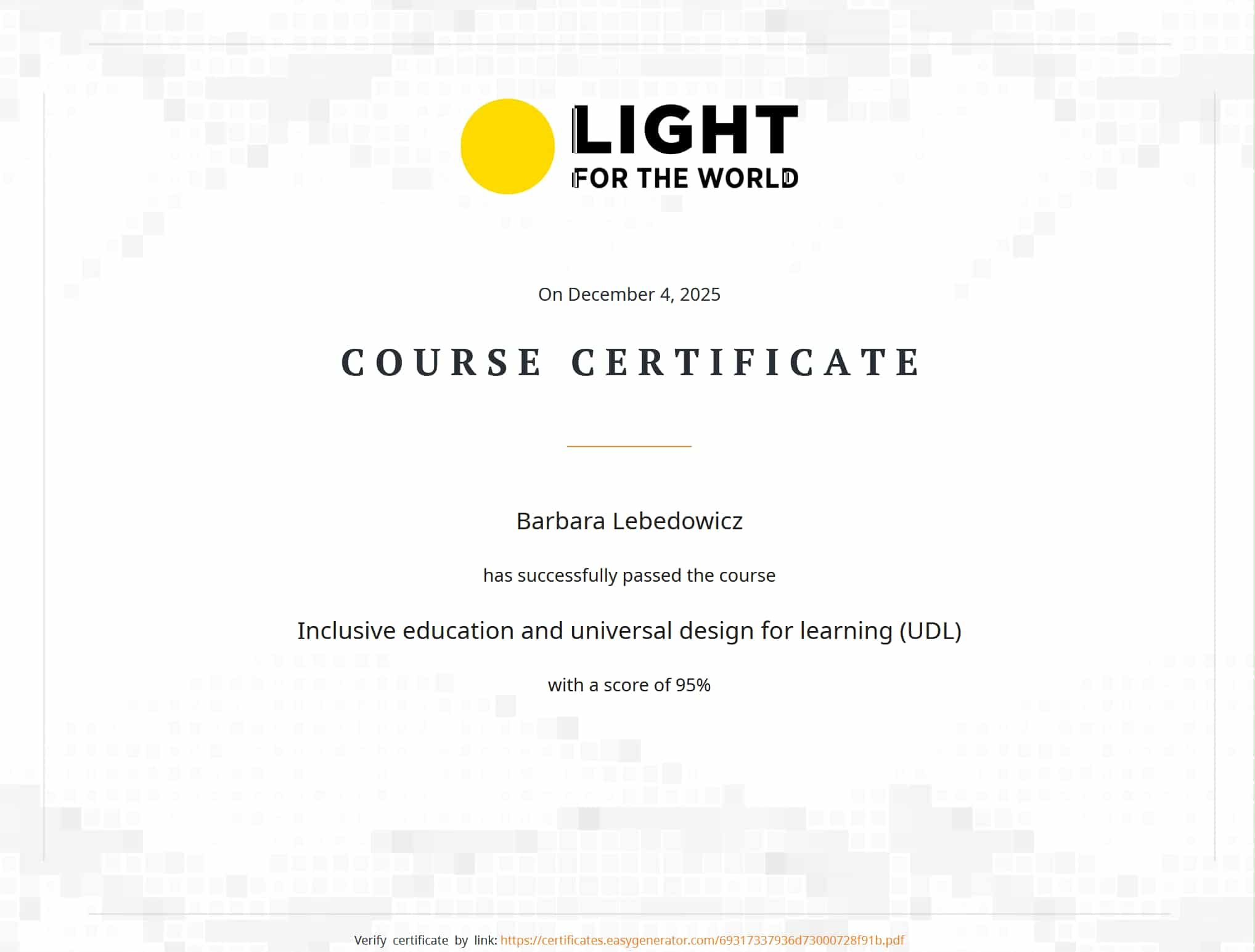
🎓✨ We are delighted to share that we have obtained the Inclusive Education and Universal Design for Learning (UDL) certificate. This is an important step in developing educational practice based on accessibility, equality, and respect for diversity.
What is UDL?
Universal Design for Learning (UDL) is an approach to educational design that assumes learner diversity is the norm, not the exception. The concept was developed by the organization CAST and is grounded in research from neuroscience, cognitive psychology, and inclusive pedagogy.
Instead of adapting teaching only after difficulties arise, UDL encourages designing learning processes from the outset in a flexible way, reducing barriers and enabling participation for the widest possible group of learners.
UDL is based on three core principles:
- 🎯 Engagement – diverse ways of motivating learners and building a sense of meaning, safety, and agency;
- 👀 Representation – presenting content in varied formats: text, image, sound, movement, and experience;
- ✍️ Action and Expression – multiple ways for learners to demonstrate learning outcomes: speaking, writing, acting, creating.
UDL in children’s education
In children’s education, UDL helps create environments in which:
- different developmental paces and learning styles are considered already at the planning stage,
- neurodivergent children and children with disabilities can participate without stigmatization,
- assessment is supportive rather than selective.
Research shows that applying UDL principles increases student engagement, improves comprehension, and reduces exclusionary and challenging behaviors
(CAST, 2018; Meyer, Rose & Gordon, 2014).
UDL in adult education
In adult education, UDL is particularly important due to the wide diversity of participants’ life, educational, and cultural experiences.
Applying UDL:
- increases learners’ sense of safety and motivation,
- supports people with migration experience, educational interruptions, and neurodiversity,
- enables the integration of formal, non-formal, and informal learning.
Research and analyses of European projects show that flexible learning formats aligned with UDL increase course completion rates and the practical use of competencies in professional contexts.
Examples of good practice
- offering a choice of assessment formats (presentation, project, interview, portfolio),
- educational materials available in multiple formats (simplified text, audio recordings, graphics),
- clear structure of classes and assessment criteria,
- project-based learning grounded in participants’ real-life experiences.
Conclusions
UDL is not a set of “additional accommodations,” but a way of thinking about education. It is an approach that:
- shifts responsibility from the individual to the system,
- supports inclusive education without stigmatization,
- improves the quality of learning for everyone.
Obtaining the UDL certificate is another step for me toward an education that does not exclude, shame, or force adaptation, but instead creates conditions for learning and growth 🌱
References / sources
- CAST (2018). Universal Design for Learning Guidelines version 2.2
- Meyer, A., Rose, D. H., Gordon, D. (2014). Universal Design for Learning: Theory and Practice
- European Commission (2021). European Pillar of Social Rights Action Plan